Guangzhou Lvyuan Water Purification Equipment Co., Ltd. is an industrial filter manufacturer founded in 2009 that designs and manufactures stainless steel filter housings, stainless steel sterile water tanks, filter elements, filter bags, ultra-polymer materials, and sintered filter products. Buyers choose Lvyuan for OEM/ODM support, ISO9001 quality control, and multi-country certifications.
Guangzhou Lvyuan Water Purification Equipment Co., Ltd.
Incoming Quality Control Checklist for Bulk Filter Housings Guide
A bulk order of stainless steel filter housings can look fine in the photos and still cause trouble. Common problems include a thread standard that does not match your pipework, a cartridge that will not seat, or an unspecified gasket material. Others are rough internal welds, or a mill certificate that cannot be matched to any part in the carton. Incoming quality control (IQC) is where you catch these problems while the supplier can still replace, rework or credit the goods. This guide gives buyers, quality teams and OEM engineers a practical checklist. It covers what to prepare before the shipment lands, which checks to run on arrival, how to sample a bulk lot, and what to write into the PO so the results hold up in a dispute.
What Should Incoming Inspection of Filter Housings Cover?
Incoming inspection of filter housings should confirm six things, in this order:
The shipment matches the PO and the paperwork.
The material is the one you specified.
Welds and surfaces are acceptable.
Dimensions and connections fit your system.
Seals and closures work.
The units survived transit.
A sampled leak test sits on top of these, with a pressure defined by your approved specification.
The order matters because the checks get slower and more expensive as you go down the list. A wrong label takes seconds to find. A weld defect needs light and a trained eye. A leak test needs equipment and time. Running the cheap checks first lets you reject or quarantine a lot before spending effort on the expensive ones.
Set the Acceptance Baseline Before the Shipment Arrives
Inspectors can only reject what the contract defines as a defect. Four items should exist before the goods arrive.
An approved drawing or specification sheet. It should state the model, material grades for each part, connection type and size, closure type, finish and rated pressure and temperature. Where the supplier publishes ratings, such as the 87 psi (6 bar) and 176°F (80°C) maximum listed on the mobile stainless steel filtration cart page, those figures come with qualifiers. The supplier’s own wording on that page ties them to cartridge, seal and operating conditions. Your acceptance criteria should name the exact conditions you need.
A golden sample or approved first article. Keep one unit, with photos, as the physical reference for finish, weld appearance and fit. “Polished” and “good weld” are subjective until a sample defines them.
A defect classification. Sort defects into three groups:
Critical: wrong material, leak, wrong connection, an element that will not seat.
Each class gets its own rule. A single critical defect can fail a lot, while minor cosmetic marks may be tolerated up to a limit.
A sampling plan. The widely used framework is ISO 2859-1. BSI’s summary of ISO 2859-1:2026 describes AQL-indexed single, double and multiple sampling plans for lot-by-lot inspection. It also covers rules for switching between normal, tightened, reduced and skip-lot inspection. The same summary notes that AQL sampling reduces reliance on costly 100% inspection. The standard supplies the statistical structure. You still decide which characteristics count as critical and which AQL levels fit your risk.
A Risk-Weighted Approach Beats Checking Everything
A common assumption is that the safest policy is to inspect every unit for every characteristic. In practice, that usually backfires. Inspectors fatigue, depth of checking drops, and the slow checks (leak tests, material tests) become bottlenecks that get skipped under delivery pressure.
A better rule is to match inspection depth to how costly and how detectable each defect is:
Check 100% of fast, high-consequence features. Examples are the connection type and size, label and model, port caps and visible shipping damage.
Sample the slow or destructive checks. Examples are PMI, internal weld inspection, dimensional measurement and pressure testing.
Tighten sampling after any failure. Relax it only after several clean lots, following the switching logic in ISO 2859-1.
This applies when you have a stable supplier and the housings are not safety-critical. For first orders, new designs, hazardous media or regulated hygienic service, increase sampling and consider third-party witnessing.
A clean pre-shipment inspection report also does not replace incoming inspection. The pre-shipment report describes the lot at the factory. IQC verifies what actually arrived, after transit, against your specific piping and process.
Incoming Inspection Checklist by Stage
The table below is a working template. Adjust the methods and rejection triggers to your drawing and risk level.
Stage
What to verify
Typical method
Common rejection triggers
1. Documents and marking
PO number, model, quantity, batch or serial marks, certificates, traceability
Compare packing list, labels and certificates to the PO
Certificate cannot be tied to the lot; label or model mismatch
2. Material identity
Grade of body, head, basket or mesh, clamps, fasteners
Certificate review, sampled PMI, lab test if disputed
Molybdenum absent in a part specified as 316L; certificate does not match marking
EN 10204 defines standard types of inspection documents for metallic products. Under that catalogue summary, a type 3.1 certificate is issued by the manufacturer and validated by an authorized inspection representative independent of production. A type 3.2 certificate is also signed by the purchaser’s inspector or one designated by official regulation.
If you need a 3.1 or 3.2 certificate, write it into the PO. Then check what it actually covers. A material certificate describes a material heat or lot, not the finished housing. Ask whether the heat number is traceable to the housing body, head and basket. For commodity housings, lot-level traceability is often what you will realistically get. For critical service, require part-level marking.
Material verification: what PMI can and cannot prove
Specifying 304 or 316L is easy. Proving it on a delivered unit takes more care.
A magnet test proves nothing useful. Austenitic stainless steels can become slightly magnetic after cold working, and a magnet cannot tell 304 from 316L.
Handheld XRF PMI is a good screen. It can detect molybdenum, which separates 316-type from 304-type steel.
PMI usually cannot confirm the “L”. Handheld XRF generally cannot measure carbon, so low-carbon status depends on the mill certificate or a laboratory test.
Test the right parts. Housing bodies are often 316L while baskets, clamps, bolts and fittings differ. Specify which components need which grade, and test each one.
Weld, finish and passivation checks
Inspect welds on both outside and inside surfaces. Look for incomplete fusion, cracks, porosity, undercut, spatter and heat tint. Heat tint is the straw-to-blue discoloration near welds, and it signals a surface that may need cleaning before it resists corrosion as expected. Rust spots on new stainless often point to iron contamination from tools or handling, not to a wrong grade. In either case, ask the supplier about its descaling and passivation practice.
ASTM A967 covers several chemical passivation treatments for stainless steel parts and includes recommendations and precautions for descaling, cleaning and passivation. If you need passivation, state the standard and method in the PO, along with any test or documentation you require.
For hygienic housings, finish is the second trap after material. “Polished” is not a specification. State a roughness limit (Ra), where it is measured (inside wetted surfaces versus outside), and how it is verified. Alfa Laval explains that Ra is an average of surface peaks and valleys. It also cautions against treating Ra as a complete indicator of hygienic quality, so pair the number with visual and cleanability criteria. Many food and process-water applications do not require bioprocessing-grade finishes, so specify what your process needs rather than the strictest grade on the market.
Dimensions and connection fit
Fit errors are among the most frequent and most avoidable IQC failures, because they come from small spec differences rather than poor workmanship. Check:
Thread standard and pitch (NPT versus BSP are not interchangeable even at the same nominal size).
Flange standard, bolt circle, hole count and facing.
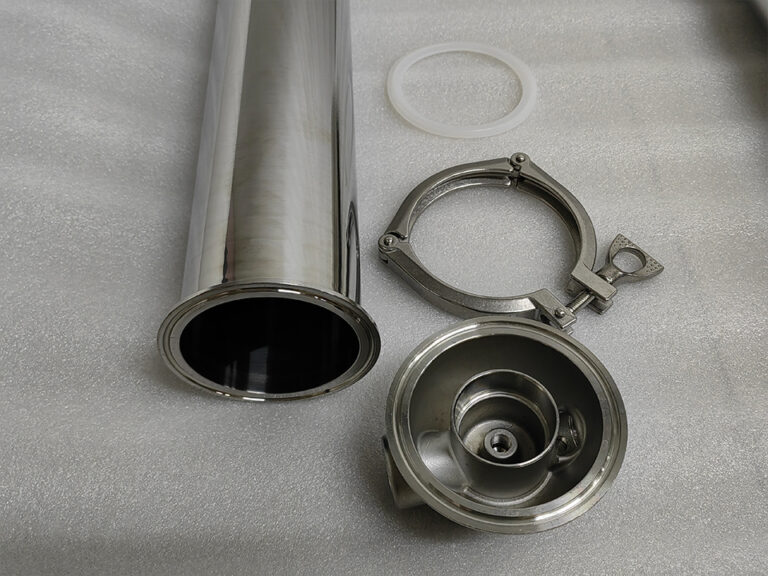
Tri-clamp ferrule size and gasket compatibility.
Port position and overall height, which affect skid layout and clearances.
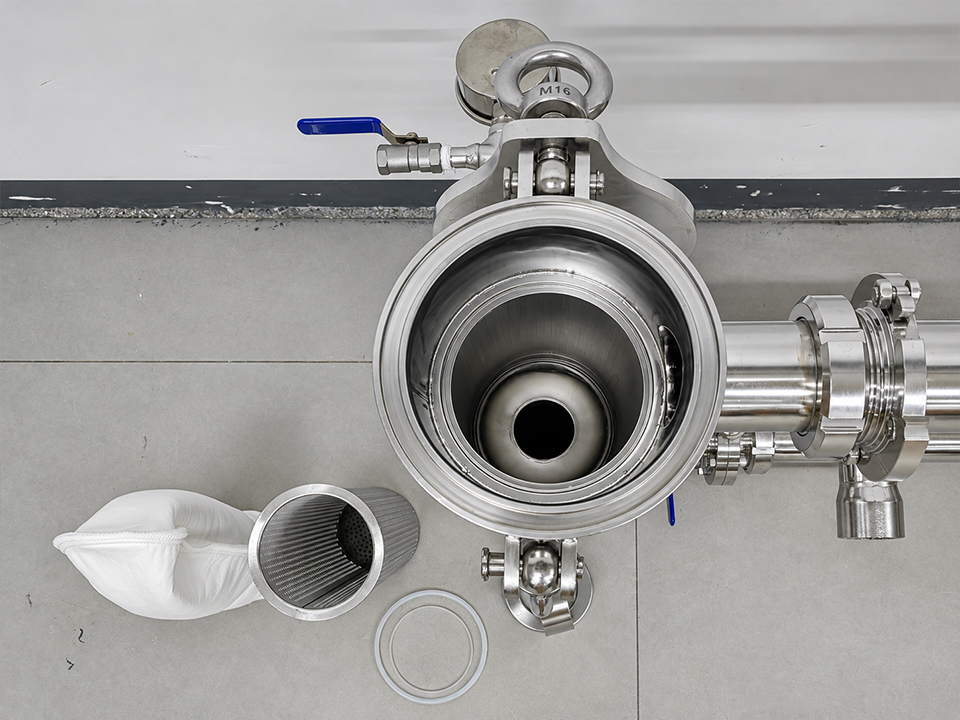
Whether your actual filter element, bag or basket seats correctly.
The last item is the one most often skipped. Fit-test the real consumable, not a drawing dimension. A housing that is dimensionally “in tolerance” can still fail to seal a bag or cartridge that has its own tolerance stack.
Illustrative example (hypothetical, not a customer case): a distributor receives 300 housings with female threaded ports. Sample checks pass visual and weld criteria, but a thread-gauge check shows the ports are a different standard from the buyer’s pipework. A 100% check of port type, which takes seconds per unit, would have caught this at the dock.
Seals, closures and functional checks
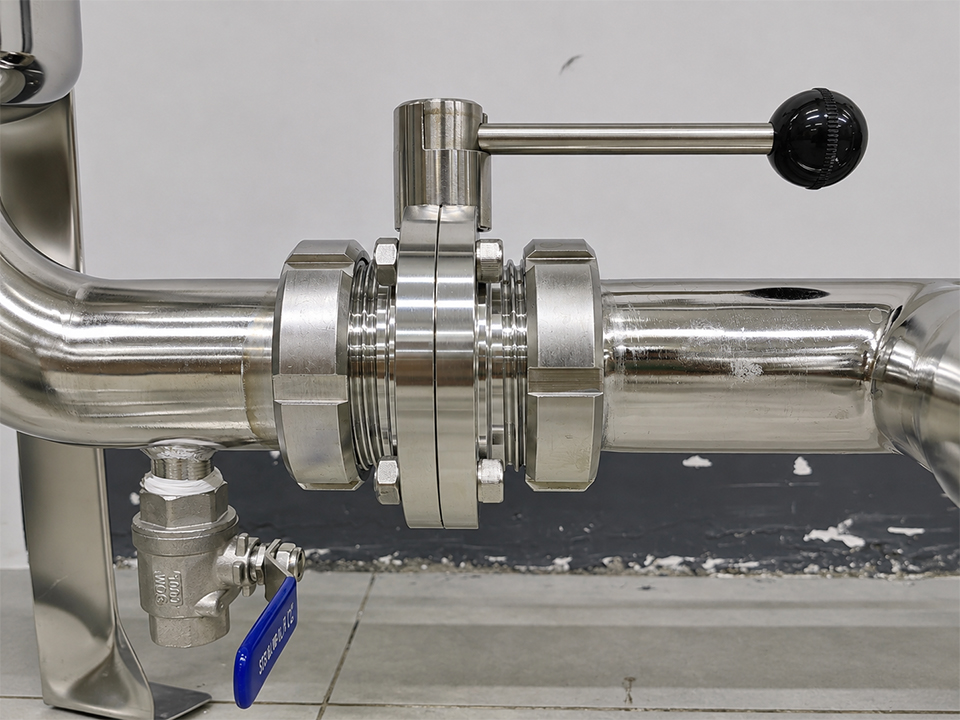
Verify the gasket or O-ring material against the process fluid and temperature, and confirm it is seated correctly in a clean groove. Open and close every sampled closure. Clamp-band closures, swing eye bolts and bolted covers should engage without galling, and the cover should seat evenly.
If a leak test is part of your acceptance plan, three rules apply:
Take the test pressure from your approved specification and the applicable code, not from a generic number.
Do not exceed the rating of any gauge, gasket or fitting in the test setup.
Dry and clean the unit afterward, especially for hygienic service. Ask the supplier about acceptable water quality for stainless steel testing.
Product-Specific Checks: What Changes by Housing Type
The generic checklist above is the base. Each housing design adds its own failure points.
Housings and strainers that look similar in a catalogue fail in different ways. A sintered element behaves differently from a perforated basket, and a clamp closure differs from a bolted flange cover.
Housing type
Highest-risk checks
Fit verification
Sanitary cartridge housing
Weld and finish on wetted surfaces, clamp gasket seating, vent and gauge ports
Clamp ferrule size, cartridge seating
Single cartridge housing (threaded)
Thread standard, closure sealing, head casting surface, gasket material
Mesh or cartridge element fit
Flanged sintered housing
Flange facing and bolt pattern, bolted cover alignment, element seating
Flange standard against your piping
Basket strainer
Basket condition, perforation or mesh specification, cover and bolts, drain
Basket seats fully in body, cover closes
Side-entry bag housing
Seal surface where the bag ring sits, cover bolts, inlet and outlet position
Correct bag size (#1 or #2) and bag-ring fit
Mobile filtration cart
Pump and piping welds, valve and gauge function, frame and wheels
Connection sizes, electrical and pump compatibility
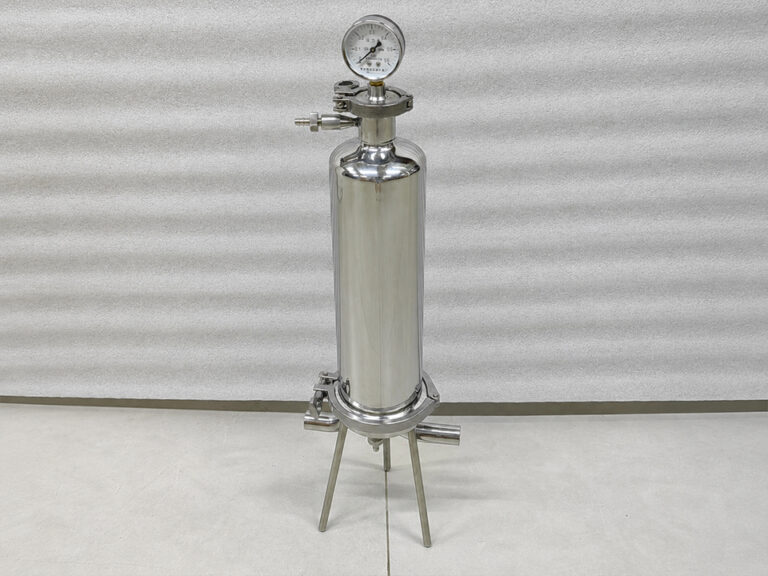
For sanitary service, the stainless steel sanitary cartridge filter housing page describes a polished vessel with clamp connections, a pressure gauge, a vent connection and a clamp-band closure. For this style, prioritize finish, clamp-gasket seating and vent and gauge ports. For threaded designs such as the stainless steel single cartridge filter housing, which lists threaded ports, a quick-release clamp and a removable mesh element, thread standard and closure sealing move to the top of the list.
Where the pipeline is flanged, as with the flanged stainless steel sintered cartridge filter housing, compare the flange standard, bolt circle and facing against your piping before anything else. Confirm the sintered element seats correctly, and check the cover alignment. Sintered elements also bring a media-specific question: whether the delivered element’s rating and material match the specification.
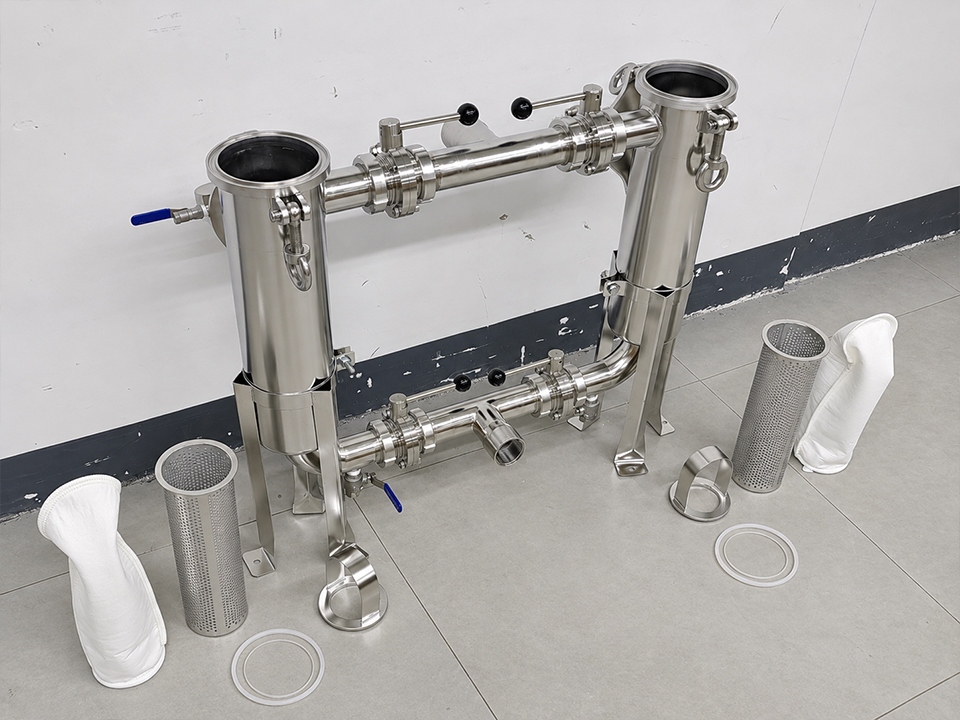
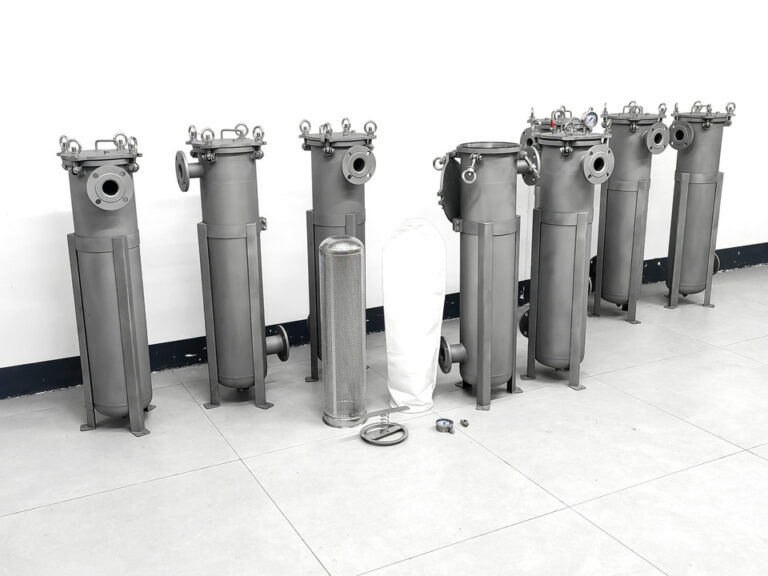
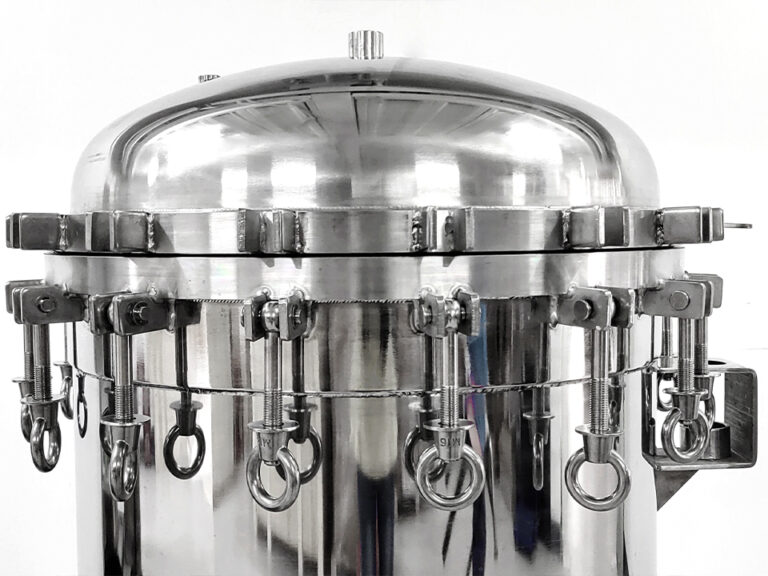
Basket strainers deserve their own look because their “filter” is a perforated or mesh-lined basket. The stainless steel basket strainer page lists a lift-out perforated basket, optional wire-mesh lining and swing-eye-bolt cover, with filtration ratings set by perforation and mesh selection. Measure and record the perforation or mesh specification, confirm the basket seats fully, and check that the bolts and cover close evenly. The industrial basket strainer with a quick-access cover is described with a bottom drain, pressure gauge and vent arrangement. When that is your configuration, test the drain and gauge ports as part of the functional check, not as afterthoughts.
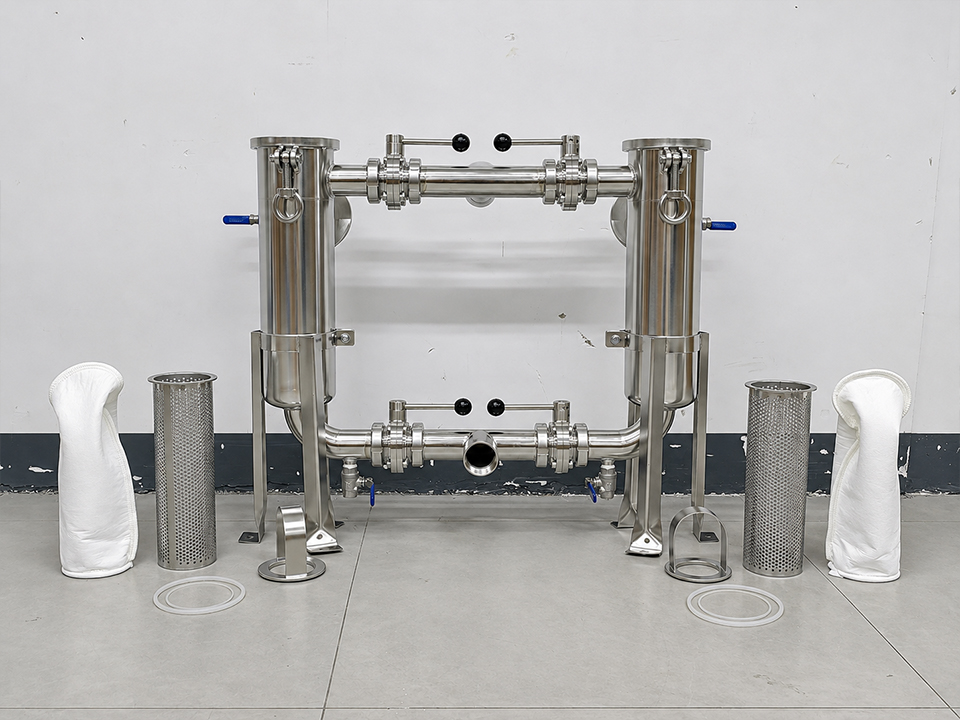
For bag-style units, bag size is the compatibility check that gets missed. The side-entry stainless steel bag filter housing page states that #1 and #2 are the standard bag sizes for that configuration. Confirm the delivered housing matches the bag size you stock, and fit a real bag to check the seal at the bag ring. Integrated skids need their own plan. If you buy complete assemblies, treat the pump, valves, instruments and piping as separate inspection items alongside the housings.
Handling Nonconforming Goods
Decide in advance what happens when a lot fails.
Quarantine, do not install. Tag the lot as held so suspect units do not enter your assembly line or field stock.
Document with evidence. Record photos, measurements, sample size, defect type and unit identifiers. A claim without measurements invites dispute.
Know your claim window. Put the inspection period and remedy (replace, rework or credit) in the PO. Delays erode your claim.
Agree on re-inspection. Specify whether a failed lot is 100% sorted by the supplier, and whether a re-submitted lot gets tightened sampling.
Ask for corrective action. For repeated defects, require a root cause and a corrective action, not just a replacement.
What Should Buyers Specify Before Requesting a Quote?
Incoming inspection works only if the order documents give you something to inspect against. Before you send an RFQ for a bulk order, prepare the following:
Model and configuration: housing type, element or bag size, number of cartridges or bags.
Material by component: body, head, basket or mesh, clamps, bolts and gaskets, with grade for each.
Connections: type, size, standard, facing and port position.
Pressure and temperature ratings for your actual duty, plus any test pressure you require.
Surface finish: Ra limit and location, whether electropolishing or passivation is required, and the standard.
Documentation: EN 10204 certificate type, traceability level, test reports, packing list format.
Marking and labeling: model, batch or serial marks, grade marks.
Acceptance criteria: defect classes, sampling plan, golden sample reference and claim period.
Packaging requirements: port caps, sealing-face protection and carton strength for your shipping method.
If you are sourcing from a manufacturer for the first time, ask for a sample unit and the inspection records that will accompany the lot before you place the full order. Send these requirements with your quote request so the supplier can price and plan inspection into production.
Frequently Asked Questions
What is an incoming quality control checklist for filter housings?
It is a structured list of checks a buyer runs on receiving filter housings. It covers documents, material identity, welds and finish, dimensions and connections, seals and closures, leak testing and packaging damage. Each check has a method and a defined accept or reject criterion.
How many filter housings should I inspect from a bulk order?
Use a sampling plan such as ISO 2859-1 rather than a fixed percentage. Check fast, critical features like connection type on every unit, and sample slower checks like PMI and pressure tests. Tighten sampling for first orders, new suppliers or after a failure.
Can a handheld PMI gun confirm 316L?
It can confirm molybdenum, which separates 316-type from 304-type steel, but handheld XRF generally cannot measure carbon. Confirming the low-carbon “L” grade relies on the mill certificate or laboratory analysis. Test each specified component separately, because the body and fittings may differ.
Do I need an EN 10204 3.1 certificate for filter housings?
Not always. It is worth requiring when material traceability matters, such as hygienic, chemical or regulated service. A 3.1 certificate is manufacturer-issued and validated by an independent authorized representative. Confirm what lot or heat it covers and whether it links to marked parts.
How do I check the surface finish of a sanitary filter housing?
Specify a roughness limit (Ra), the surface it applies to and the verification method in the PO. Then measure sampled units with a surface-roughness tester and inspect welds and wetted surfaces visually. Ra alone does not describe cleanability, so also compare against the golden sample.
Should I leak test every filter housing I receive?
Usually not. Sample-based testing is common, with 100% testing reserved for critical or hazardous service. Use the test pressure from your approved specification and the applicable code, and never exceed the rating of gauges, gaskets or fittings in the test setup.
What should I do if a lot fails incoming inspection?
Quarantine the lot, document defects with photos and measurements, and notify the supplier within the claim period in your PO. Request replacement, rework or credit as agreed, require corrective action for repeat defects, and re-inspect the corrected lot under tightened sampling.