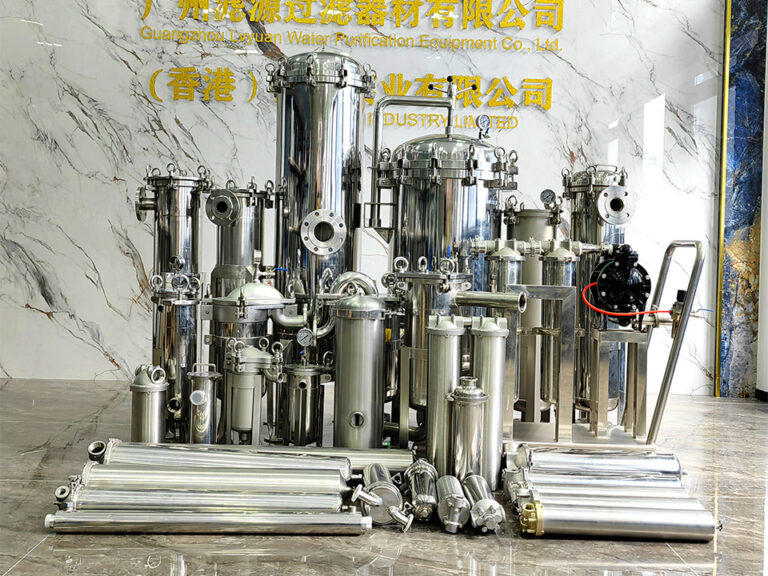
Guangzhou Lvyuan Water Purification Equipment Co., Ltd. is an industrial filter manufacturer founded in 2009 that designs and manufactures stainless steel filter housings, stainless steel sterile water tanks, filter elements, filter bags, ultra-polymer materials, and sintered filter products. Buyers choose Lvyuan for OEM/ODM support, ISO9001 quality control, and multi-country certifications.
Guangzhou Lvyuan Water Purification Equipment Co., Ltd.
What Documents Prove Filter Housing Compliance for Customers?
A filter housing is proven compliant by a connected document pack, not by a single certificate. The pack normally includes a datasheet that states rated pressure and temperature together, a material declaration covering the body and the seals, pressure-test records, a supplier quality-system certificate that can be verified, and regulatory or contact-material paperwork only where the application requires it. For customers buying plastic housings for water treatment or process liquids, the practical problem is rarely a missing certificate. It is a certificate that does not say which model, material, or batch it covers. This guide explains what each document proves, what it leaves unproven, and how to request evidence that your own customers or auditors will accept.
What Is in a Credible Document Pack for a Plastic Filter Housing?
Compliance is a set of claims. The housing is made of the stated resin. It holds the stated pressure at the stated temperature. The seals match the order. The factory runs a controlled process. The product meets any rules that apply in the destination market. Each document supports one or two of those claims. None supports all of them.
The table below shows what each common document can and cannot establish. Customers comparing single-bag and multi-cartridge formats can also review the wider bag filter housing range to see which configurations a supplier actually lists before deciding which documents to request.
Document
What it can prove
What it does not prove
What to check
Datasheet or drawing
Model, body material, connections, cartridge or bag size, rated pressure and temperature
That any testing was done
Model code matches the quotation; pressure and temperature limits are stated together
Material declaration
Body resin (for example PP, PPH, PVDF, UPVC, or FRP with optional liner) and wetted components
Chemical suitability for your fluid
Resin type named for every wetted part, including basket and cover
Seal declaration
Gasket or O-ring elastomer (for example EPR/EPDM, silicone, Viton/FKM, PTFE)
Service life in your process
Seal type matches the purchase order, with no substitution
Pressure-test record
A tested unit or batch met a stated test condition
Performance at higher temperature or in different media
Test pressure, hold time, medium, temperature, pass criterion, sample size, serial or batch reference
ISO 9001 certificate
The supplier’s management system was audited by a certification body
That a specific housing conforms to a specification
The manufacturer states the product meets named legislation or standards
That the declaration is correct or that the unit was inspected
Exact legislation and standards listed, model covered, signatory, date
Contact-material declaration (only if relevant)
Suitability of named materials for drinking water or food contact
Suitability of parts not listed
Standard or regulation named; every wetted part covered
Final inspection report or certificate of conformity
This shipment matches the order
Anything about earlier or later batches
Purchase order number, quantity, batch, visual and dimensional results
Is an ISO 9001 Certificate Enough to Prove Housing Compliance?
No. ISO 9001 certifies a quality management system, not a product. DQS, a certification body, explains that the standard specifies requirements for a system that supports consistent delivery of conforming products and does not certify the products themselves. A supplier can hold a valid certificate and still ship a housing whose seal differs from the quotation.
Treat the certificate as a screening tool. It tells you the factory has documented processes, internal audits, and corrective-action routines. It does not tell you what resin was molded last Tuesday.
Two checks make the certificate more useful:
Verify it independently.IAF CertSearch is a global database for confirming the authenticity of management-system certificates issued by certification bodies accredited by IAF MLA signatories. A PDF sent by email is a claim until it is confirmed.
Read the scope and address. A certificate that names a trading office, a different legal entity, or an unrelated product scope does not describe the factory molding or assembling your housings.
Lvyuan’s website describes ISO 9001 quality control and multi-country certifications at company level. The product pages reviewed for this article list specifications rather than certificate numbers or named standards. Customers should therefore request the current certificates and model-level documents for each housing at the RFQ stage, rather than assuming a general statement covers a specific model.
Why Pressure and Temperature Evidence Must Be Read Together
Thermoplastic housings lose pressure capability as temperature rises. A rating stated as one pressure and one temperature, without saying whether both apply at the same time, is incomplete. This is where documents most often fail to answer the real question.
The published specifications for Lvyuan’s plastic housings illustrate why. These figures come from the supplier’s own product pages. Confirm them against the datasheet and test basis issued with your order.
Housing type (supplier-listed)
Listed pressure
Listed temperature
Listed seal options
Document question to ask
PP bag housing
87 psi (6 bar) at 20°C
Max. 140°F (60°C), subject to pressure derating
Not listed on the page
What pressure applies at 60°C?
UPVC bag housing
Max. 87 psi (6 bar), subject to operating conditions
Max. 122°F (50°C), subject to pressure derating
Not listed on the page
Is there a derating table, and does a hot flush exceed 50°C?
PVDF bag housing
Max. 100 psi (6.9 bar)
Max. 212°F (100°C)
Viton (FKM), EPDM, PTFE
Do pressure and temperature maxima apply simultaneously?
PPH multi-cartridge housing
Up to 116 psi (8 bar)
Up to 194°F (90°C)
EPR, silicone, Viton
Is 8 bar valid at 90°C, or only at lower temperature?
FRP multi-cartridge housing
Up to 150 psi (10 bar)
Up to 140°F (60°C)
EPR, silicone, Viton
What is the basis for the 10 bar rating?
The “document question” column is not a criticism of any listing. Product pages are summaries. The controlling document is the datasheet or test record that accompanies the order. Customers should ask for the condition behind each number.
Here is an illustrative example, not a real customer case. A system integrator specifies a UPVC bag housing for a process line running at 45°C. The datasheet lists a 50°C maximum. A weekly hot flush reaches 55°C. No certificate in the pack would flag this mismatch, because every certificate could be valid. Only a comparison of the datasheet limit against the operating profile catches it.
For each housing family, the product page is the right starting point for the listed configuration:
A pressure-test record is only as useful as its detail. “Tested OK” proves very little. A usable record states:
The model and serial number or production batch tested.
Test pressure and hold time.
Test medium (water, air) and temperature.
The pass or fail criterion, such as no leakage or visible deformation.
Whether every unit was tested or a sample was taken.
Date, inspector or operator, and sign-off.
If the supplier tests a sample rather than every unit, that is not automatically a problem, but the document should say so. Customers can then decide whether sampling is acceptable for the application, or whether 100% testing should be written into the order. The right answer depends on the consequence of failure, installation pressure, and the fluid. A low-pressure sediment line carries a different risk than a chemical dosing line.
How Should Material and Seal Declarations Be Checked?
A material declaration should name the resin for every part that touches the process liquid. Body, retainer basket, cover, and seal are often specified separately, so a compatible body can be paired with an unsuitable seal.
Key points to verify:
Resin identity. PP, PPH (polypropylene homopolymer), PVDF, UPVC, and FRP behave differently in temperature capability and chemical exposure. The declaration should name the material as quoted, not a generic “plastic.”
Seal identity. EPR/EPDM, silicone, Viton (FKM), and PTFE have different chemical behavior. Confirm the seal on the declaration, the quotation, and the inspection record is the same.
Chemical compatibility. A supplier’s statement that a resin is “chemical resistant” is not a compatibility confirmation for your fluid. Provide chemical name, concentration, temperature, and exposure pattern (continuous, intermittent, cleaning cycles). Then request a written compatibility response, or supply your own compatibility data.
Colorants and additives. If a customer specification restricts substances, ask whether the declaration covers additives and pigments, not only the base resin.
When Do Regulatory and Contact-Material Documents Apply?
Not every housing needs every document. Asking for irrelevant certificates adds cost and lead time without reducing risk. Three regimes come up most often, and each is conditional.
Pressure equipment rules in the EU. The Pressure Equipment Directive 2014/68/EU applies to the design, manufacture, and conformity of pressure equipment with a maximum allowable pressure greater than 0.5 bar. It covers equipment new to the EU market whether made in the EU or elsewhere. Plastic housings rated at 6 to 10 bar are above that pressure, so the question is legitimate. But classification also depends on factors such as fluid group, volume, and nominal size. Equipment below the directive’s thresholds is treated differently, without a PED CE marking. Customers shipping to the EU should ask the supplier to state in writing which legislation it considers applicable and why, rather than accepting a generic “CE” statement.
Drinking-water contact.NSF/ANSI 61 establishes minimum health-effects requirements for chemical contaminants indirectly imparted to drinking water by products, components, and materials used in drinking water systems. It matters if the housing will sit in a potable water system and local code or the end customer requires it. It is not a relevant requirement for a housing handling process chemicals. If it applies, ask for the certification listing that names the exact product and manufacturer.
Food and beverage contact. In the EU, Regulation (EU) No 10/2011 on plastic materials and articles intended to contact food is a specific measure under Regulation (EC) No 1935/2004. That framework regulation provides that materials and articles covered by specific measures be accompanied by a written declaration of compliance. This applies only where the housing or its parts are intended to contact food. If a supplier claims “FDA compliant,” ask which regulation is meant, which parts are covered, and whether the claim extends to the seals.
What Is the Better Test: More Certificates or Better Linkage?
The conventional assumption is that more certificates mean lower risk. That holds only when each certificate can be tied to the specific product. A thick folder of generic certificates with no model codes is weaker than a short pack in which the datasheet, material declaration, seal declaration, test record, and inspection report all reference the same model and batch.
Use this linkage test on any pack:
Does the model code on the datasheet match the quotation and the packing list?
Does the resin named in the material declaration match the datasheet?
Does the seal on the inspection report match the purchase order?
Does the test record reference a serial or batch number that can be traced to the shipment?
Does each certificate name the legal entity and factory address that actually produces the goods?
If the answer to any of these is no, the document may be genuine and still not prove compliance for your order. There is one exception. For a small, low-risk purchase, a datasheet and a final inspection report may be proportionate. Heavier documentation fits higher-pressure, chemical, potable-water, or regulated applications.
Which Documents Should Travel with Each Shipment?
Factory certificates describe the supplier. Shipment documents describe your goods. For repeat orders, ask for a lot-specific set:
Final inspection report with dimensional and visual results.
Pressure-test record or confirmation of the agreed test method.
Certificate of conformity referencing the purchase order, model, quantity, and batch.
Seal and material confirmation matching the order.
Packing list with model codes that match the paperwork.
Customers who resell or integrate housings into skid systems should also decide in advance which documents their own customers will request, such as datasheets, drawings, and declarations. That way the documents can be obtained during sampling rather than after a complaint. Customers comparing plastic and other housing categories can use the industrial plastic filter housings category as the entry point for the PP, PPH, PVDF, UPVC, and FRP options.
What Should Buyers Specify Before Requesting a Quote?
Compliance documents are cheapest to obtain when they are part of the original RFQ. Include:
Destination market and applicable rules, so the supplier can state which legislation it considers relevant.
Application and intended contact: drinking water, food or beverage, process chemical, or general water treatment.
Fluid details: chemical name, concentration, temperature range, pressure profile, and any cleaning or flushing cycles.
Housing format and connection: bag or cartridge, bag size or cartridge length, connection type and size.
Seal material, with no substitution without written approval.
Required documents, listed by name: datasheet, material declaration, seal declaration, pressure-test record, certificate copies, certificate of conformity.
Test requirements: whether every unit or a sample is tested, and the test condition.
Document language, format, and retention expectations.
Sample and pre-shipment inspection requirements.
Ask the supplier to confirm in writing which of these documents are available for each model before the order. Also ask which ones would require an additional test or third-party certification, with its cost and lead time. A supplier who answers clearly and quickly is usually giving you useful information about how its quality system works.
Frequently Asked Questions
What documents prove filter housing compliance?
A datasheet with stated pressure and temperature, a material and seal declaration, pressure-test records, a verifiable ISO 9001 certificate, and a certificate of conformity for the shipment. Regulatory or contact-material declarations are added only when the application or destination market requires them.
Is ISO 9001 enough to prove a filter housing is compliant?
No. ISO 9001 covers the supplier’s quality management system, not a specific product. It is useful for screening a factory, but it does not replace material declarations, pressure-test records, or shipment-level inspection documents for the actual housing ordered.
Does a plastic filter housing need CE marking?
It depends on the applicable legislation. The Pressure Equipment Directive applies to equipment above 0.5 bar maximum allowable pressure, but size, volume, and fluid thresholds affect classification. Ask the supplier to state in writing which rules it applies and why.
When do I need NSF/ANSI 61 or a food-contact declaration?
Only when the housing contacts drinking water or food and your customer, local code, or market rules require it. For process chemicals or general industrial water, these documents are usually unnecessary. When required, confirm that the claim covers every wetted part, including seals.
How do I verify a supplier’s ISO certificate?
Check the certificate’s scope, factory address, issuing body, and validity, then confirm it through the issuing certification body or the IAF CertSearch database. A PDF alone does not confirm that the certificate is current or covers the factory producing your housings.
What should a pressure-test report show?
It should show model and serial or batch number, test pressure, hold time, test medium and temperature, pass criterion, whether the test covered every unit or a sample, date, and inspector sign-off. A report saying only “passed” gives you little evidence.