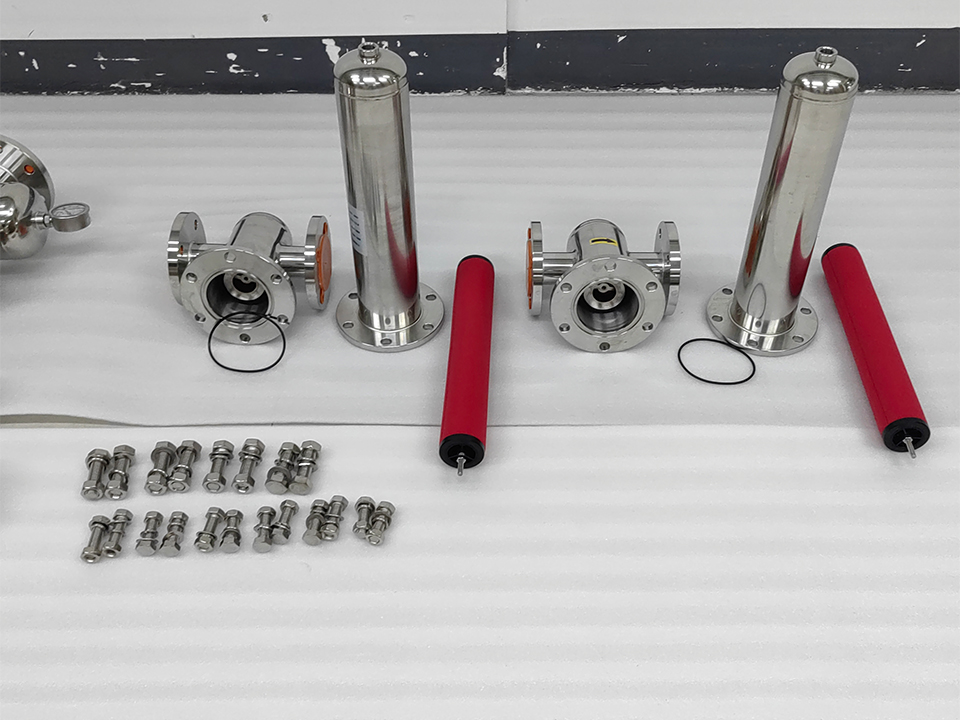
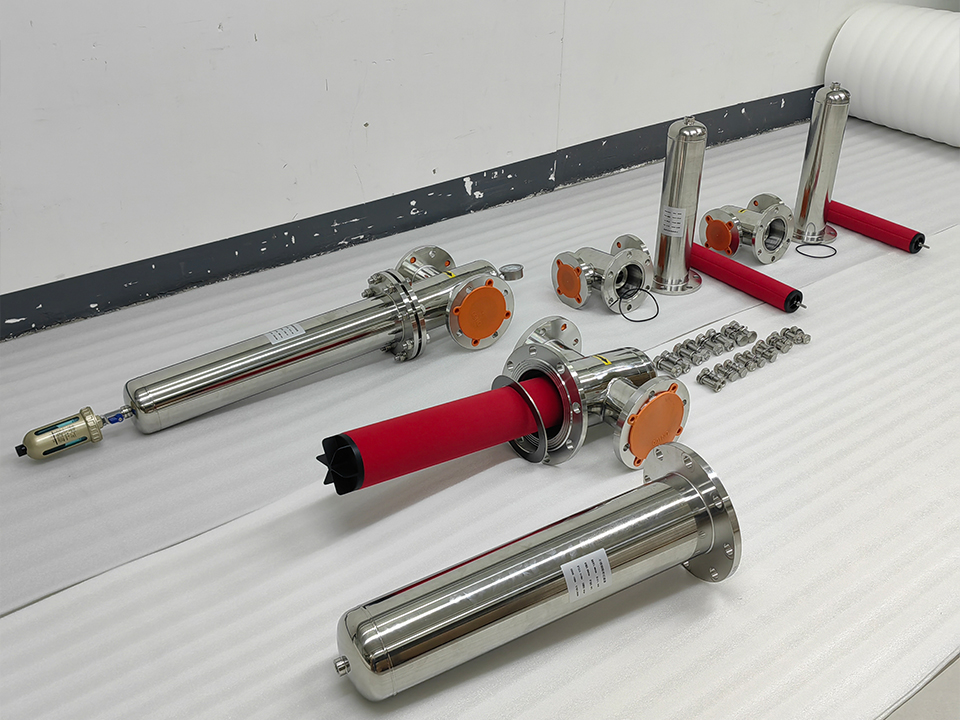
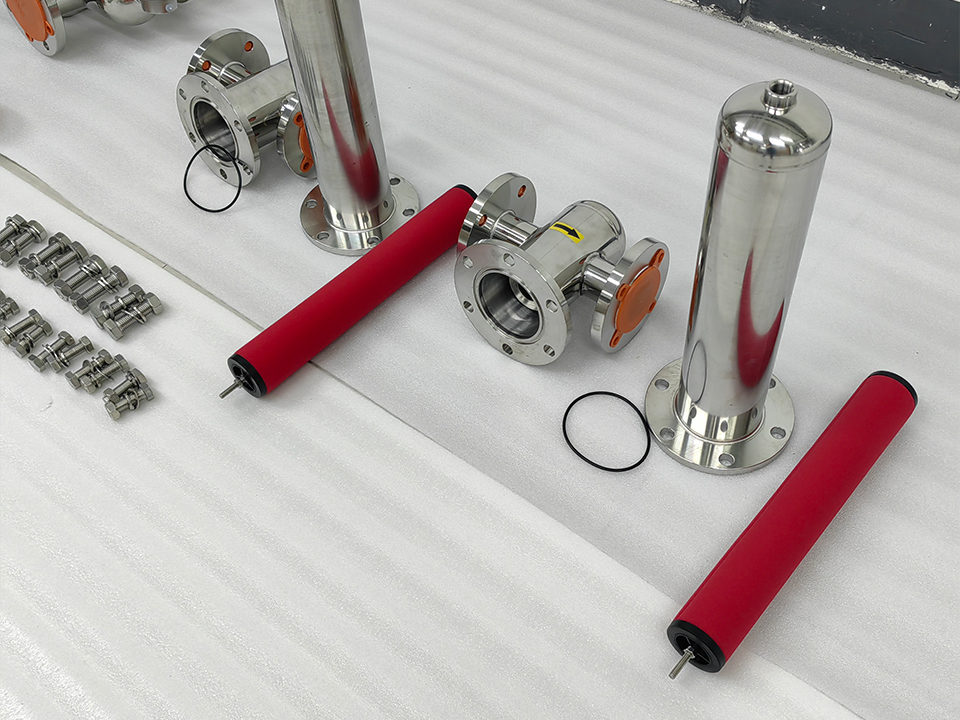
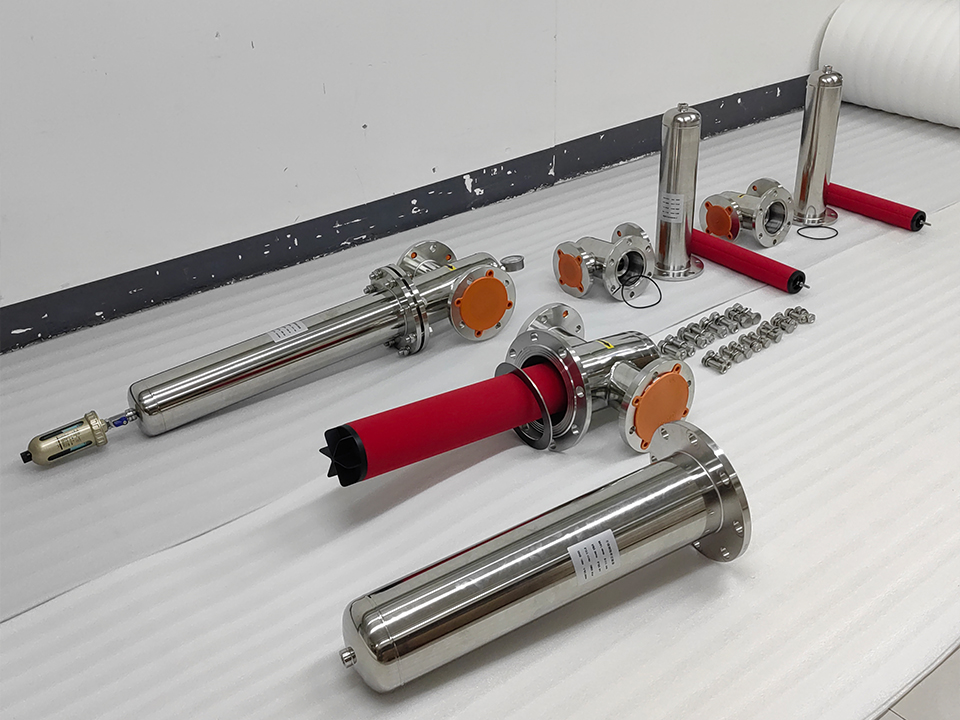
Guangzhou Lvyuan Water Purification Equipment Co., Ltd. is an industrial filter manufacturer founded in 2009 that designs and manufactures stainless steel filter housings, stainless steel sterile water tanks, filter elements, filter bags, ultra-polymer materials, and sintered filter products. Buyers choose Lvyuan for OEM/ODM support, ISO9001 quality control, and multi-country certifications.
Guangzhou Lvyuan Water Purification Equipment Co., Ltd.
Condensate Polishing Filter Housings for High-Temperature Lines
A condensate polishing filter housing on a high-temperature line has a narrower job than its name suggests. The polishing itself, meaning the removal of dissolved ions, is done by ion exchange resin, and that resin is usually more temperature-sensitive than the stainless steel vessel installed in front of it. The housing’s role is mechanical: stop corrosion products and debris before they reach pumps, heat exchangers or the resin bed, or catch resin fines after it. For buyers, the decision is therefore not only which housing survives the line temperature. It is where in the circuit filtration belongs, which component limits the temperature rating of the whole assembly, and which element suits the duty. This guide covers those decisions and the details to settle before requesting a quote.
What Does a Filter Housing Do in a Condensate Polishing Circuit?
Condensate polishing treats condensate returning from steam use so that contaminants do not carry into the boiler. According to Power Engineering’s overview of deep-bed condensate polishing, systems follow two approaches: deep beds of bead-type ion exchange resin, or powdered resin applied as a precoat on a filter element. Neither approach is a “filter housing” in the sense a purchasing team usually means. A standard housing with a strainer basket, cartridge or bag sits around the polisher and does three supporting jobs:
Hot-side protection: catching scale, rust and debris ahead of pumps, valves and heat exchangers.
Pre-polisher filtration: limiting particulate loading on the resin vessel.
Resin trapping: retaining resin beads and fines downstream. The design description for the U.S. EPR condensate polishing system states that resin traps are installed downstream of each ion exchanger to remove resin fines.
Whether a polisher is needed at all depends on the plant. The same Power Engineering article says polishing is usually unnecessary in low-pressure systems below 600 psig, where chemical dosing, gross particulate filtration and decarbonation are normally sufficient. In that case a correctly specified strainer or filter housing may be the whole solution, not an accessory to a resin system. The article is an older trade piece, so treat its pressure bands as a general guide and confirm against your boiler manufacturer’s feedwater requirements.
Why Resin Temperature Often Matters More Than Line Temperature
Ion exchange resin sets the practical temperature ceiling for polishing, and that ceiling is usually well below the temperature of a hot condensate line. A technical paper abstract on ion exchange resin performance in high-temperature condensate polishing describes growing interest in polishing at temperatures approaching and exceeding 60°C, and calls routine operation above 60°C “very stressful” for resins. The same abstract adds that deep-bed polishing has been practiced successfully at elevated temperatures when resins are chosen correctly and process design and operating practice are sound.
For a buyer, this changes the housing question. If the line is hotter than the resin can tolerate, one of two things is true:
The housing sits upstream of a cooler, so it protects equipment on the hot side and must carry the full line temperature.
The housing sits downstream of cooling, so its temperature depends on the cooler’s performance and on what happens when that cooler fails.
Neither case is solved by buying the highest-rated vessel available. Ask the polisher designer or resin supplier for the allowable inlet temperature first, then place the housing relative to that point.
Where Filter Housings Sit in a Hot Condensate Circuit
The table below separates the common positions. It uses qualitative guidance only; actual limits come from your system design and the equipment data sheets.
Position
Main job
Temperature exposure
Typical housing and element
What to verify
Hot side, before cooler or pumps
Remove coarse scale, rust and debris
Full line temperature
Basket strainer with perforated or mesh-lined basket
Seal material, pressure rating, perforation size, flashing margin
Between cooler and resin vessel
Reduce particulate load on the resin bed
Reduced, but depends on cooler performance
Cartridge or bag housing; cleanable metal or disposable element
Retention rating, differential pressure alarm, cooler-failure case
Downstream of ion exchanger
Retain resin beads and fines
Polisher outlet temperature
Cartridge housing, often duplexed or bypassed
Retention versus resin particle data, cleanliness, changeout method
Hot-line particulate filtration without cooling
Capture fine solids at line temperature
Full line temperature
Housing with all-metal sintered element
Rating of every wetted component, cleaning method, differential pressure limit
Housing and Element Options for High-Temperature Condensate
Basket Strainers for Coarse Hot-Side Protection
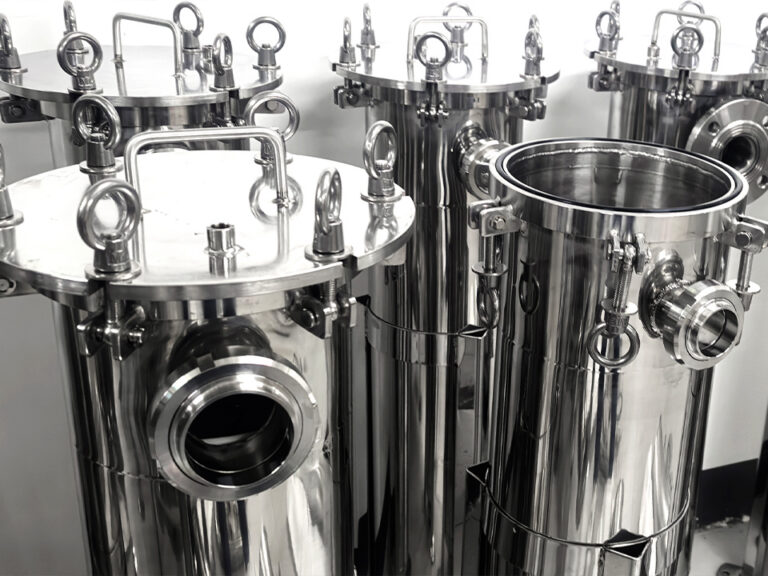
Basket strainers are the usual choice for capturing the coarsest debris. A stainless steel basket strainer with a removable perforated basket and bolted cover is listed on its product page for up to 150 psi (10 bar) and a maximum of 356°F (180°C), but that figure is stated as subject to seal material and pressure rating. Filtration ratings of 50 to 3,000 µm depend on the perforation or mesh lining selected. The listed temperature is a ceiling that holds only under specific conditions, not a guarantee for every configuration.
Basket strainers protect equipment rather than polish. A quick-access industrial basket strainer is positioned for prefiltration where the basket can be lifted out and washed as part of routine maintenance. On a hot line, that routine requires isolation, depressurisation and cooldown before the cover is opened, so a duplex arrangement or bypass is worth discussing if downtime is costly.
Cartridge Housings with Cleanable Metal Elements
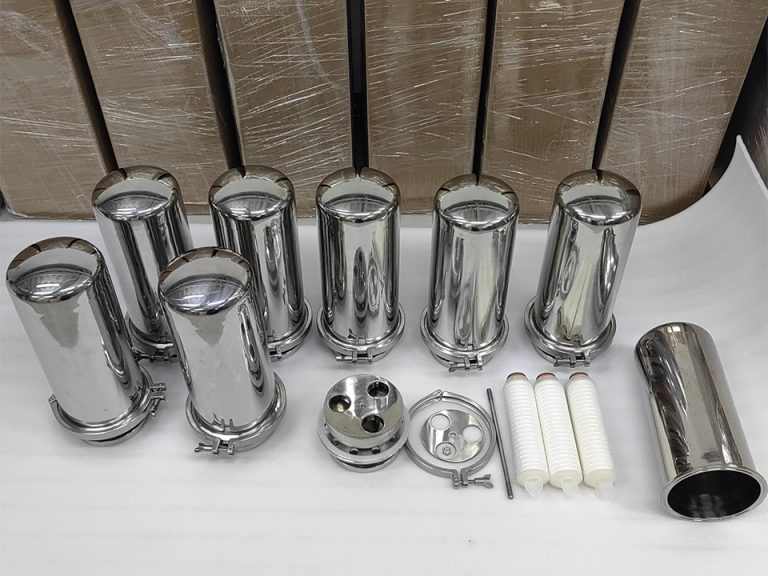
For smaller flows, sidestreams and OEM skids, a stainless steel single cartridge filter housing offers a compact vessel with a quick-release clamp closure, sealing ring and threaded ports. The clamp and sealing ring deserve early attention on hot service, because the elastomer or gasket grade often decides the usable temperature before the stainless steel does.
The element matters just as much. A cleanable sintered wire mesh filter cartridge bonds multiple woven mesh layers into a rigid structure. Its product page lists ratings from 0.5 to 100 µm, operation up to 315°C and differential pressure up to 8.6 bar (125 psi), with DOE, 222/SOE, 226/SOE and threaded ends, and cleaning by backwashing, ultrasonic cleaning or compatible chemical cleaning. Because the element is all metal, it removes a polymer from the temperature equation. The element’s rating is still not the assembly’s rating. Confirm that the end-cap style matches the housing’s cartridge seat, and use the lowest rating in the chain as your design basis.
Bag Housings for Higher Solids Loads
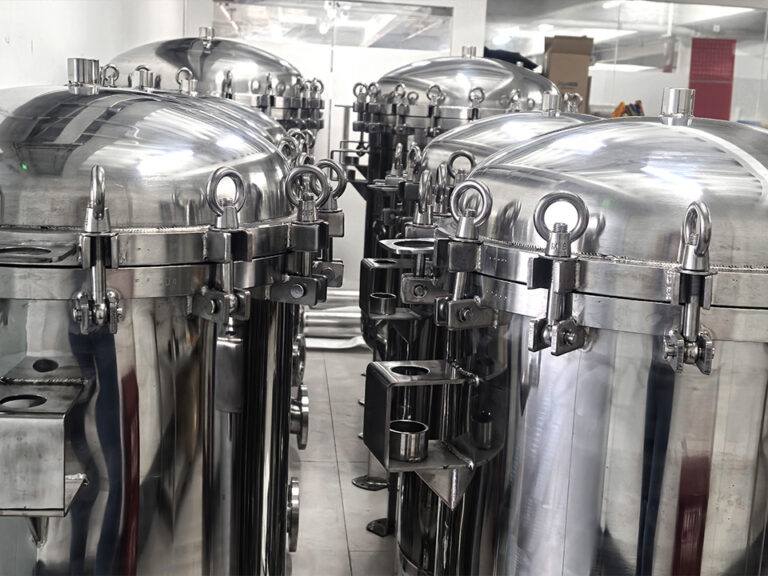
A side-entry stainless steel bag filter housing routes liquid in through the side and out through the bottom. Its product page lists 1 to 200 µm, up to 120°C and up to 10 bar. Bags generally offer more dirt-holding capacity than a single small cartridge, which can suit upset conditions with heavy corrosion-product release. The trade-off is that bag media and seams can limit temperature before the shell does, and disposable bags create changeout labor and waste. Ask for the specific bag material’s temperature rating, not only the housing’s.
Sintered Metal Tubes for Custom Assemblies
Where a standard cartridge format does not fit the equipment, an industrial sintered metal filter tube can be specified by outer diameter, inner diameter, length, pore grade and alloy. The product page lists 316L and 904L stainless steel, Monel, Hastelloy, Inconel and titanium, with pore sizes from 0.1 to 90 µm. This option suits OEM skids and custom vessels. Alloy upgrades add cost and should follow a defined chemistry or temperature need, not habit.
Option
Typical role in the circuit
Component that usually limits temperature
Maintenance model
Perforated or mesh-lined basket
Coarse hot-side protection
Cover gasket, body pressure rating
Lift out and wash
Single cartridge with sintered mesh element
Pre-polisher filter or resin trap on smaller flows
Clamp seal and sealing ring
Backwash or ultrasonic cleaning
Bag in side-entry housing
Higher solids loads, pre-polisher
Bag media and seams, cover seal
Replace disposable bag
Sintered metal tube in custom vessel
OEM and skid-mounted designs
Seal and joint design, vessel rating
Clean in place or remove and clean
Specification Factors That Decide Suitability
Rate the Whole Assembly, Not Just the Vessel
A housing’s real temperature capability is the lowest rating among its shell, cover gasket, O-rings, element, gauge and drain fittings, and the pressure at which that rating applies. Temperature and pressure ratings are often linked: a figure quoted at one pressure may not hold at another. Request a written rating for the exact model, seal material and pressure combination you intend to buy, rather than a general category figure.
Pressure Margin and Flashing
Hot condensate is often close to saturation. Spirax Sarco’s explanation of flash steam notes that flash steam is released from hot condensate when its pressure is reduced, and gives the example that water at 170°C boils at any pressure below 6.9 bar g. As an engineering inference rather than a sourced rule, a clogging element creates a pressure drop that can push near-saturated condensate toward vapor formation downstream of the element. Ask the process engineer for the margin between operating pressure and the saturation pressure at the line temperature, and set the differential pressure alarm to trip before that margin is consumed.
Material Choice and Chloride Exposure
SS304 and SS316L are the common stainless grades for filter housings, and 316L is a sensible baseline where chloride is possible. It is not a cure-all. Alleima’s technical guidance on stress corrosion cracking states that chloride-induced cracking normally occurs above 60°C and that ASTM 304 and 316 austenitic steels have limited resistance to it. Normal polished condensate has very low chloride, but the same Power Engineering article identifies condenser in-leakage of cooling water as a far more serious contamination threat. A housing that is safe in normal operation can face a different chemistry during an upset. Define the credible chloride excursion in your RFQ and let a materials engineer decide whether standard grades are acceptable, particularly for welded, stressed parts operating above 60°C.
Retention Rating and Differential Pressure
A finer rating is not automatically better. Too fine and the element loads quickly, differential pressure climbs, and the polisher may need frequent interruption. Too coarse and resin fines pass through. Obtain the required retention from the polisher designer and the resin supplier’s particle data, then choose perforation, mesh or pore grade to match. Decide at the same time how maximum differential pressure, bypass and alarm settings will work.
Cleanability Versus Disposability
Cleanable metal elements shift cost from consumables to cleaning labor and procedures. They suit sites that can backwash or use ultrasonic cleaning, and where polymer media would be limited by temperature. They require a cleaning method compatible with the alloy and the process, and validation that differential pressure recovers acceptably after cleaning. Disposable bags or cartridges simplify changeout but add recurring cost and waste handling.
Should You Choose the Housing With the Highest Temperature Rating?
Not automatically. The conventional shortcut is to match the housing to the hottest point on the process diagram. That is correct for a strainer upstream of a cooler, but it can overspecify a resin trap sitting after cooling, adding cost and sometimes lead time for no operating benefit. The opposite error is also common: specifying a downstream housing only for normal operating temperature and ignoring a cooler failure that sends hot condensate to it.
A better basis is the credible upset case at each location. Consider an illustrative scenario, not a real customer story. A plant returns condensate at roughly 95°C to a polisher whose resin supplier limits inlet temperature to about 50°C. The strainer before the cooler needs full line temperature capability. The resin trap after the polisher sees a much lower normal temperature, but a high-temperature trip on the polisher inlet may limit what it experiences during a cooler fault. The design team then decides whether the trap must survive that fault or whether the trip protects it. The numbers here are for illustration only.
Common Specification Mistakes
Quoting from line temperature alone. Without the housing’s position relative to the cooler, a quote may be wrong in either direction.
Reading the shell rating as the system rating. Seals, bags and clamps often limit service first.
Mismatched cartridge ends. DOE, 222 and 226 formats are not interchangeable, and a poor seat leaks or bypasses.
Choosing the finest micron by default. It raises pressure drop and cleaning frequency without necessarily improving protection.
No differential pressure indication or bypass. Without them, operators find a plugged element only after flow or polisher performance falls.
Ignoring upset chemistry. Material and seal choices made only for normal chemistry may not survive a chloride event.
Skipping cleanliness and finish requirements. For circuits feeding high-purity steam systems, ask about pickling, passivation and material test reports.
What Should Buyers Specify Before Requesting a Quote?
A supplier cannot recommend a suitable housing from “high-temperature condensate” alone. The following fields allow an accurate quotation and reduce rework.
RFQ field
Why it matters
Position in circuit (before cooler, between cooler and polisher, or after polisher)
Determines temperature exposure and required retention
Normal, maximum and upset temperature
Sets seal, element and shell requirements
Operating and design pressure, and vacuum conditions if any
Sets body rating and flashing margin
Flow rate and allowable differential pressure
Determines housing size and element area
Condensate chemistry, including amine or ammonia dosing and any chloride excursions
Affects material grade and gasket compatibility
Contaminant type and particle size, or resin size data for a trap
Determines mesh, perforation or pore grade
Connection type and size
Avoids adapter and piping rework
Element type, end-cap style and cleaning method
Ensures fit and a workable maintenance plan
Material, finish and documentation requirements
Includes grade, passivation, material test reports and any applicable pressure vessel code or inspection records
Quantity, delivery schedule and spares
Affects lead time and the spare-element strategy
Ask the supplier to confirm, in writing, the temperature and pressure rating for the exact configuration being quoted. For OEM or custom projects, request a sample or drawing review before committing to a production quantity.
Frequently Asked Questions
Can a filter housing perform condensate polishing by itself?
No. Condensate polishing refers to removing dissolved ionic contaminants, which is done by ion exchange resin or similar processes. A filter housing removes particles. It supports polishing by protecting equipment, reducing solids loading and trapping resin fines.
What temperature can condensate polishing resin tolerate?
It depends on the resin type and condition, so confirm with the resin supplier. Published technical work describes operation above 60°C as very stressful for resins, though it can be done with the right resins and design.
Do I need a resin trap after a condensate polisher?
Often. Resin traps are common downstream of ion exchangers to retain resin beads and fines, and the U.S. EPR design description includes them. Requirements vary by plant, so check the polisher designer’s specification.
Should I choose 304 or 316L for hot condensate filter housings?
316L is the more cautious baseline where chloride is possible, but neither grade is immune to chloride stress corrosion cracking above about 60°C. Evaluate the worst credible chloride excursion and have a materials engineer review welded, stressed parts.
Are sintered metal cartridges better than bags for hot condensate?
They can be, when temperature is the limiting factor, because an all-metal element avoids polymer limits and can be cleaned and reused. Bags may suit heavy solids loads and simpler changeout. The choice depends on cleaning capability and differential pressure.
Why does a housing’s listed temperature rating come with conditions?
Because the usable temperature depends on seal material, pressure, element and configuration, not the shell alone. Ask for a written rating for the exact model and seal you intend to buy, and use the lowest component rating as your design basis.
Is condensate polishing required for low-pressure boilers?
Not usually. A trade overview states that below 600 psig, polishing is typically unnecessary and chemical dosing, gross particulate filtration and decarbonation are normally sufficient. Check the boiler manufacturer’s feedwater requirements for your plant.